
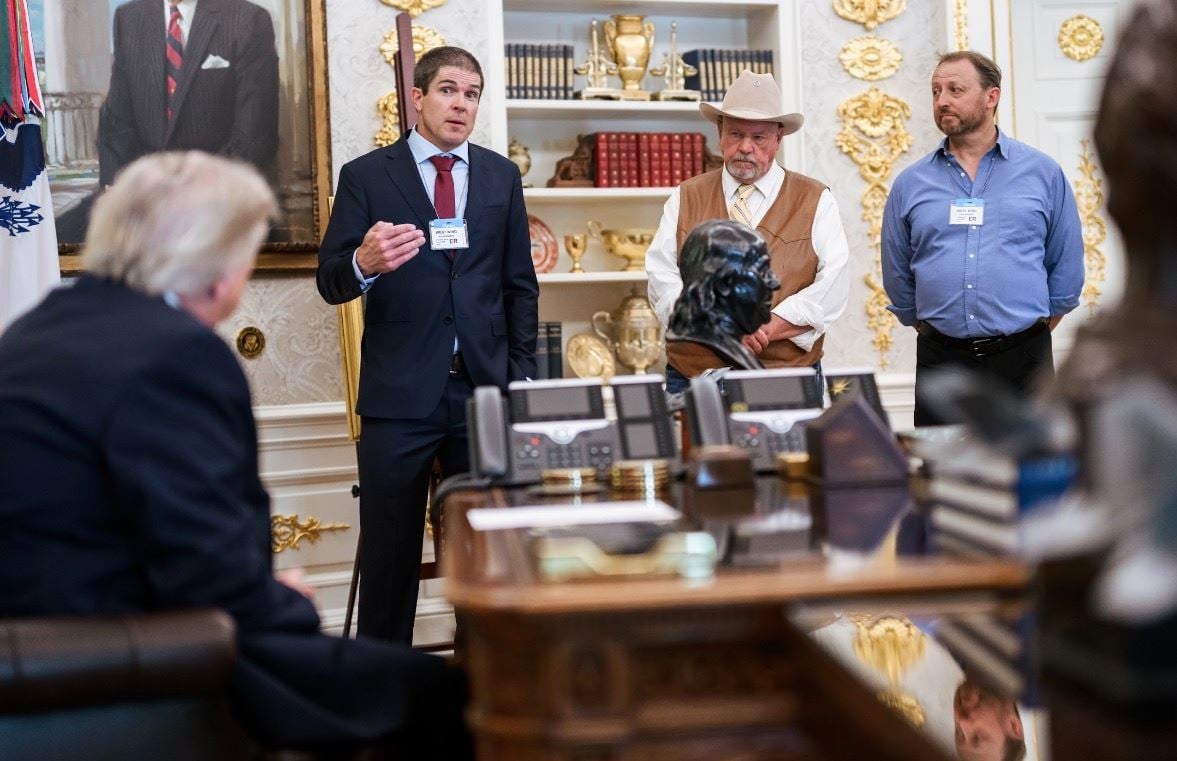
Photo by: Patrick Witty, White House Oval Office: June 25, 2026
Good Morning,
My name is Will Harris- I am a fourth-generation farmer, and I am honored to be here to tell you about my farm, White Oak Pastures in Clay County, Georgia- the poorest county in our Nation in 2020. My farm and rural town are not unique; they are victims of the economic ills that have hollowed out our rural communities over the last 80 years. Rural America, once called the “backbone” of our country, was dependent on agriculture. Many of our farm towns never had factories, plants, or mills. They had acres of productive land and entrepreneurial people who knew how to produce a bounty of livestock and crops.
After World War II, food production changed dramatically. Who had historically fed their local communities, became suppliers to large food companies. Changes like repurposing ammunition plants made chemical fertilizers cheap and available to farmers. These sorts of technologies gave food production an abundance. We describe these changes in food production in three ways:
Commoditization: no longer striving to produce the best food, but producing food THAT MET a minimum standard- the commodity standard. Food producers moved from pridefully producing premium products to focusing exclusively upon efficiently meeting the minimum acceptable grade. (As offered by JBS, Cargill, National, and Tyson) This concession made a disastrous impact on the rural economy, our land, water, air, and our human health.
Industrialization: using the tools of science to make food production cheap and plentiful, specifically with pesticides, chemical fertilizers, TILLAGE, etc. (Provided by Bayer and Syngenta and others). This has had horrible unfortunate effects on our land’s health.
Centralization: establishing large mills, plants, and factories to industrialize the processing of food to cheapen it with little regard to the nutritional impact. (Like Nestle, PepsiCo, and Kellogg’s) This has had a disastrous impact on our nation’s wellbeing and rural America’s economic health.
These major shifts were accelerated by our Secretary of Agriculture in 1971 – 1976, Early Butz, who embraced “Get Big or Get Out” which ultimately broke most of our mid-sized farms who had historically fed our communities- but who Mr. Butz felt was incapable of feeding our Nation. Big Food Companies displaced farmers and small-town food purveyors taking over the provision of food to consumers. Convenience and price replaced quality and nutrition as the most important attributes of food value. Dietitians, physicians, and nutritionists were silenced by the influence of highly effective messaging from Big Food Companies. Big Agricultural Commodity Companies became the essential partners of Big Food Companies- one could not survive without the other: Big Food Production needed Big Food Distribution, and this resulted in unholy alliances. The food production system that had previously been very cyclical quickly evolved into being a completely linear system. A system that impoverished rural communities.
I do not believe that Big Ag, Big Food, Big Tech, and Big Medicine conspired to intentionally degrade our food to make Americans wrongly nourished and sick, but that is the unintended consequence and it is specifically what has occurred.
Whether this horrible wrong was founded in conspiracy, or not, I cannot determine. I do know that changing our multi-trillion-dollar food production and distribution industry will be onerous, slow, expensive, unpopular, and painful. I am grateful to you, this administration, to have the courage to initiate this change. Our nation will not be truly free unless we can feed ourselves. Not reversing this epic evolution of mistakes will be the continuous detriment of our health, our society, our economy, and our ecology.
Thomas Jefferson warned of concentrated corporate power wrongly persuading our government for the betterment of a few, as opposed to the many. In the 1930’s there were over 6 million farms to produce our Nation’s food. Today, the farmer population is the lowest of all time- only 1.8 million farmers to feed our growing population of 350 million people in America.
For too long, our country has prioritized global trade to the detriment of domestic resilience. We are now suffering the effect of these choices in our newly formed dependence in the fragility of imports and hostile relationships from nations on whom we depend to feed us.
Farmers are entrepreneurs, and we will evolve as we have through previous market adjustments. But if changes are not made, it can become too late. We are currently dominated by these linear systems that are rendering our rural communities impoverished, our people sick, our land degraded, and our National Security vulnerable. We are in the midst of a major shift in land transition- away from farmers to high-net-worth individuals who know how to properly manage land. To reverse this, we need: greater transparency in labeling laws, equitable prices, access to markets, and the support of our administration to operate with the same common-sense agenda you have taken with other facets of our government. Those of us in this room are committed professionals who want to teach others what we have learned over the last 30 years- to work with Nature to provide an abundance.
My farm, White Oak Pastures is one example of rethinking food production. We’ve vertically integrated, building two USDA processing plants on our farm in Bluffton, Georgia. We’ve created full-time, non-minimum wage jobs for 160 local people. We’ve increased the organic matter in our soil from less than .5% to over 5% in the last 20 years. The wildlife is thriving, the rainwater is recharging our aquifers, our streams are clear, our pastures are sequestering carbon. We raise 10 species of livestock, make our own compost from processing plant waste, we turn fat into tallow products, and hides into pet chews.
I started a 501c3 nonprofit called “The Center for Agricultural Resilience” which is designed to train farmers on how to transition away from the commodity system- we’ve trained over 1,000 farmers over the last 15 years, and I hope I have the opportunity to train thousands more. America needs more farmers, and better farmers, not less.
God bless our Nation, the hands that produce our food, and the mouths that eat it.
Respectfully Submitted,
Will Harris


